Axion Deep Digital Research / April 2026
The State of Small Business Websites 2026
What 292 audits revealed about mobile performance, accessibility, and the technical foundations of organic reach.
Three numbers that define this report
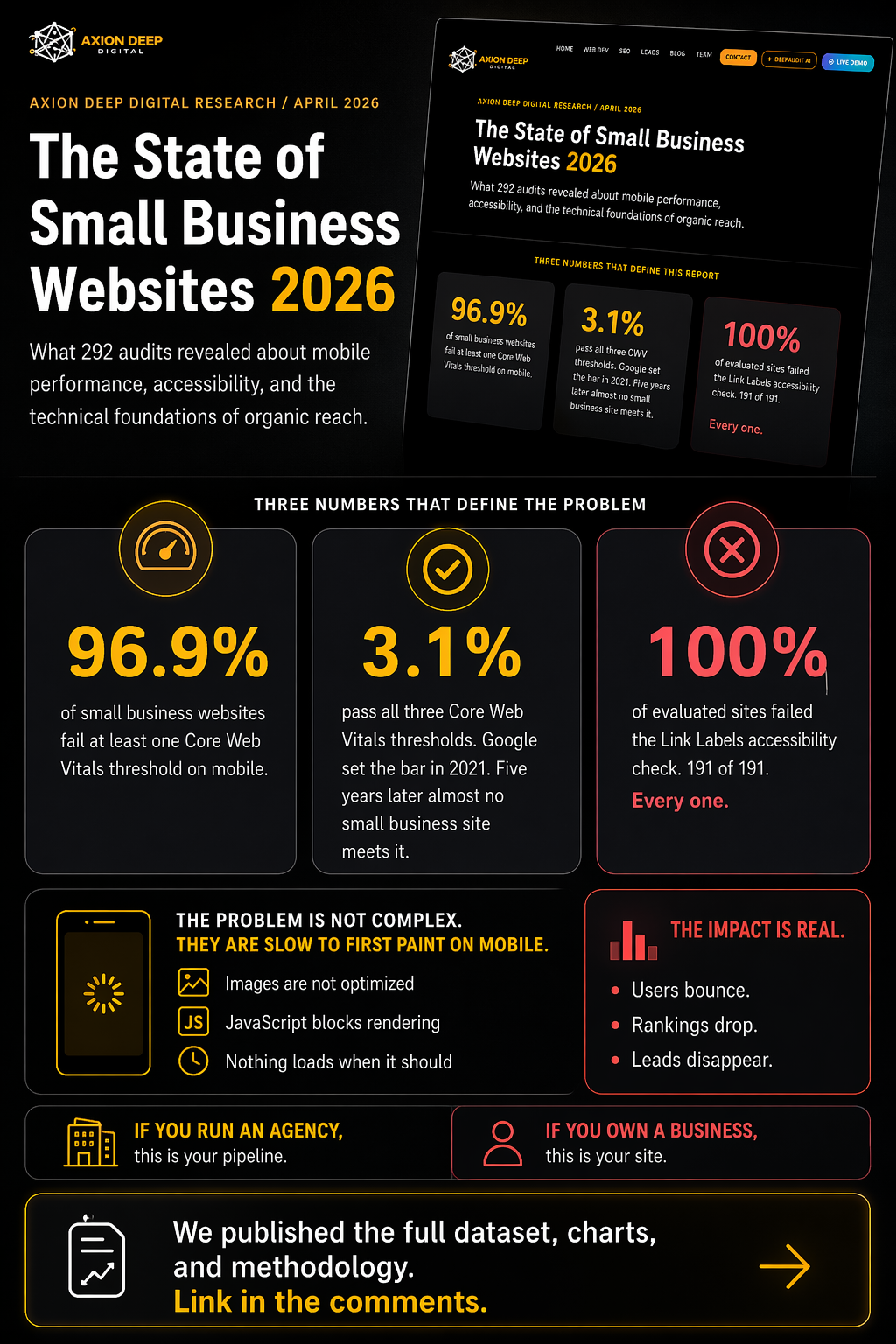
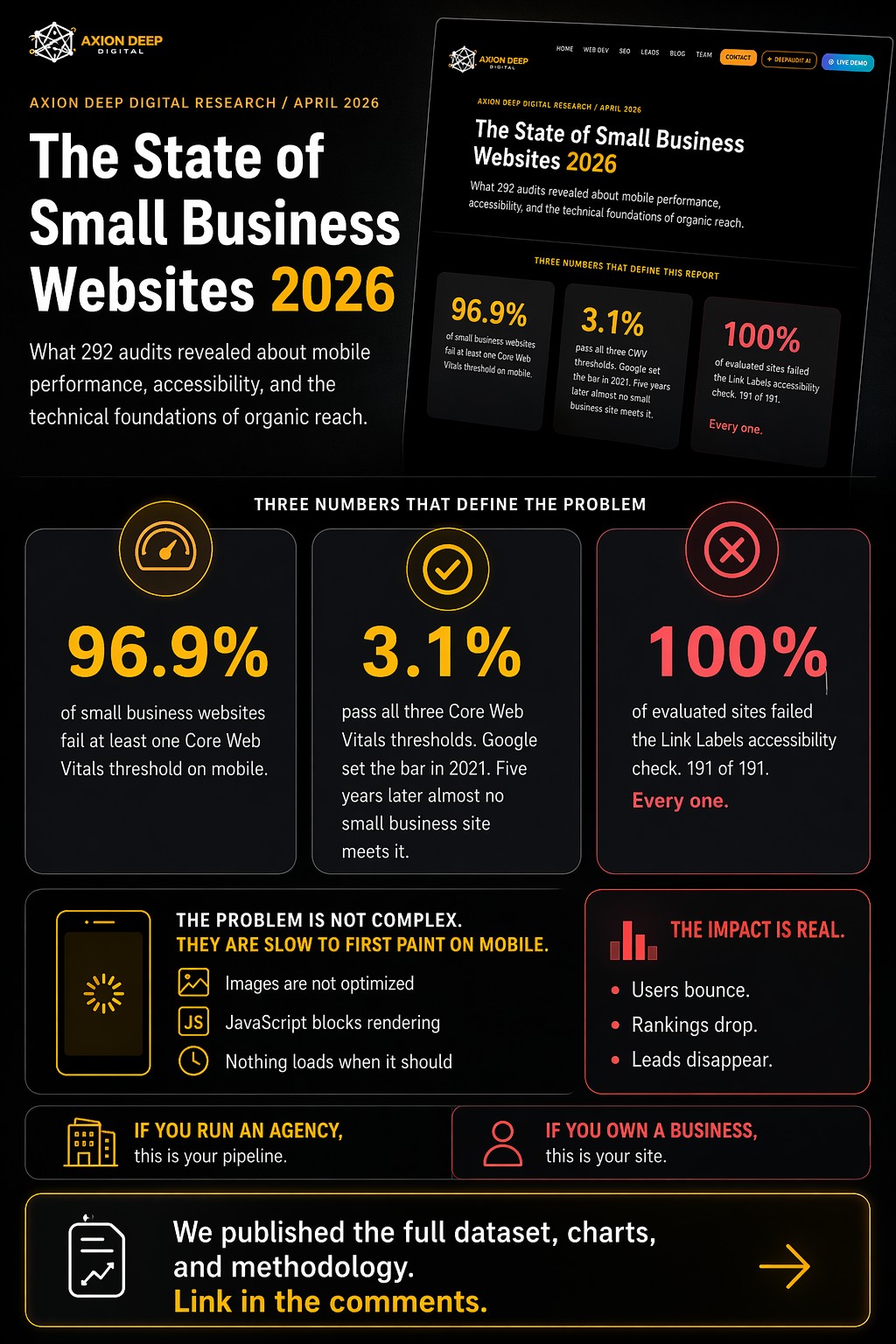
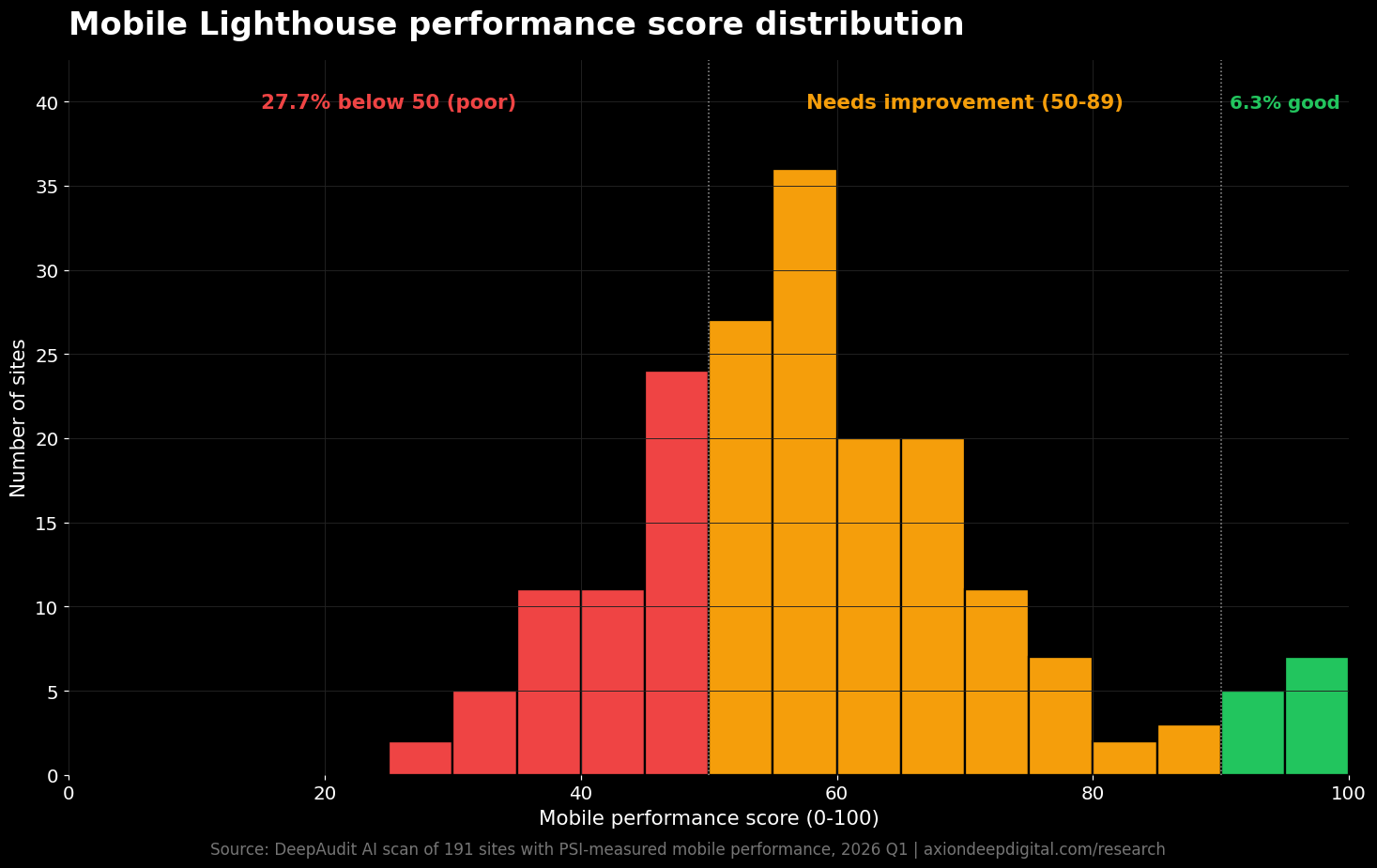
of the 191 sites returning valid mobile Lighthouse data failed at least one lab performance threshold (LCP, FCP, or CLS).
pass all three CWV thresholds. Google set the bar in 2021. Five years later almost no small business site meets it.
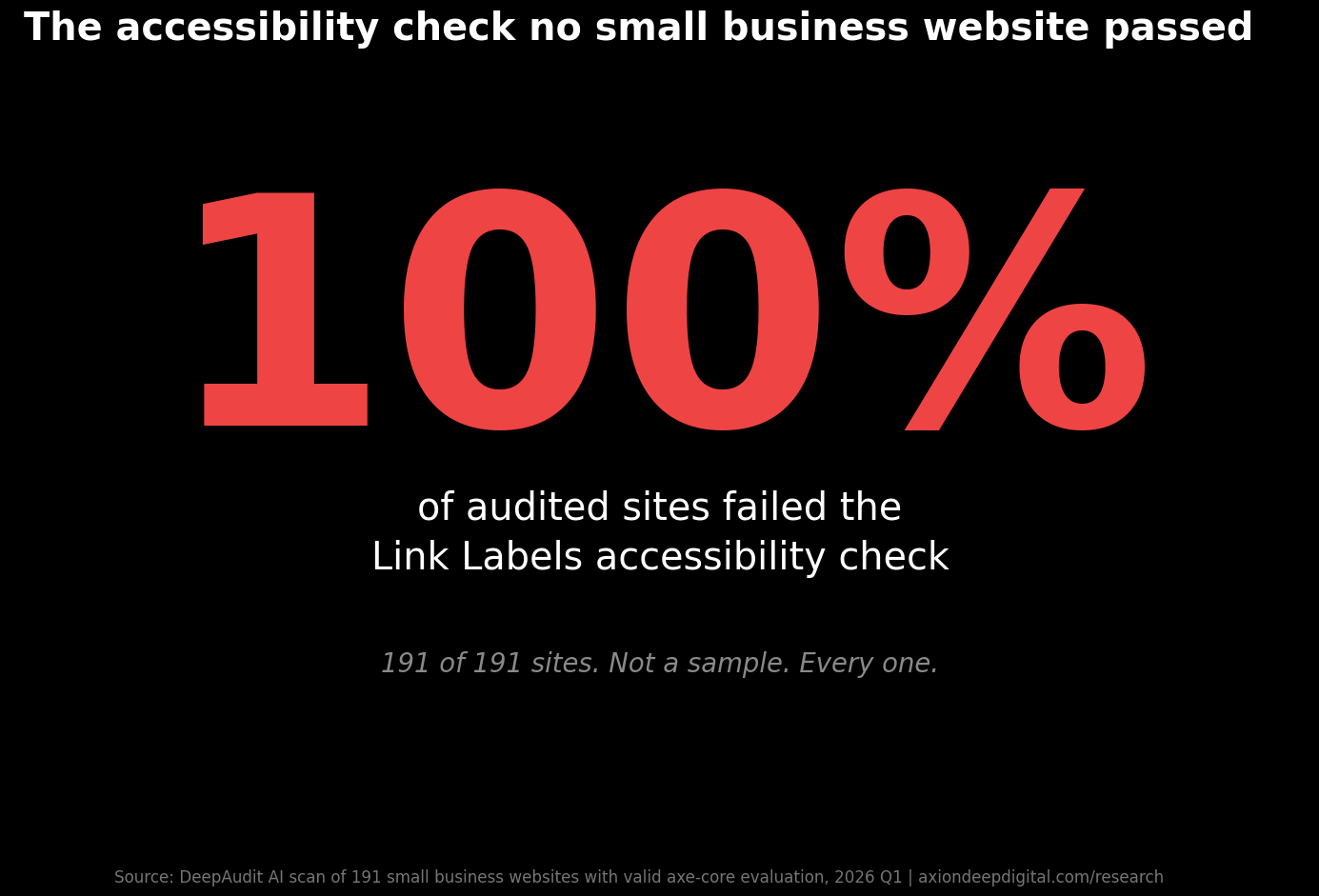
of evaluated sites failed the Link Labels accessibility check. 191 of 191. Every one.
The pattern is consistent across industries, regions, and site ages. The modern small business website is fundamentally broken at the technical level.
Open data, open methodology.
292-row dataset. Anonymized. CC BY 4.0. Reproducible from published code.
Share this research

Free to use under CC BY 4.0 with attribution to Axion Deep Digital.
Press & Citations
Cite this report
This research is published under CC BY 4.0. You may quote any finding, reproduce any chart, and redistribute the full dataset. We ask only for attribution back to the source.
Peer-reviewable preprint
This study is archived as a citable academic preprint on SSRN: papers.ssrn.com/sol3/papers.cfm?abstract_id=6719299
Short citation
APA
Chart embed (copy & paste)
<img src="https://www.axiondeepdigital.com/research/sbw-2026/03-link-labels-100pct.png"
alt="100% of audited small business websites failed the Link Labels accessibility check. Source: Axion Deep Digital."
width="1600" height="900" />
</a>
Cited by
Coverage, references, and pickups
Mentions of this research land here as they happen. Spotted a reference, citation, or news pickup? Send it to support@axiondeepdigital.com and we'll add it.
For SEO & web dev agencies
96.9% of the sites we could validly test failed a mobile lab threshold. That's your pipeline.
If you run an agency, the 292 sites in this report are a statistical mirror of your prospect list. Every small business you're about to pitch is probably in one of these rows. They don't know it yet.
Walk into your next sales call with one finding from this report and a 60-second audit of the prospect's live homepage. You're not selling services anymore. You're showing them the problem they already have, with a number on it, backed by 291 other sites that share it.
Quote any statistic. Embed any chart. The license is CC BY 4.0, attribution is all we ask.
Executive summary
We ran 292 small business websites through DeepAudit AI, a headless Chromium renderer that measures over 100 technical SEO, performance, accessibility, and security factors the way Google actually sees a page. The sample was drawn from a North American B2B prospect list in 2026 Q1.
The pattern is consistent across industries, regions, and site ages. The modern small business website is fundamentally broken at the technical level. Three findings carry the report:
- 96.9% of the 191 sites with valid mobile Lighthouse data failed at least one lab threshold. Only 3.1% passed all three. These are Lighthouse lab measurements of LCP, FCP, and CLS, not Google's field Core Web Vitals, which are LCP, INP, and CLS. We did not measure INP and we collected no field data, so this is not a claim about how Google scored these sites in production.
- The failure pattern is specifically about first paint, not layout stability. 86.4% of sites post poor mobile Largest Contentful Paint. 72.4% post poor mobile First Contentful Paint. Meanwhile 85.5% pass Cumulative Layout Shift. Small business websites are not jittery. They are slow to first content on a phone.
- 100% of evaluated sites failed the Link Labels accessibility check. Not most. Not 95%. Every single one of the 191 sites where we got a valid axe-core evaluation failed it.
The report that follows walks through each finding, the methodology behind it, and what it means for small businesses competing for organic reach against Fortune 500 budgets. The full dataset is published under CC BY 4.0. The code that produced these numbers is open source. Anyone can reproduce these findings or verify their own site's row in the dataset.
Methodology
The sample
292 small business websites, audited between February and April 2026.
Sites were sourced from a B2B prospect list (ZoomInfo), which skews the sample toward North American small businesses in sales-visible verticals: professional services, industrial supply, B2B software, marketing and sales technology, regional construction and trades.
This is not a random sample of the web. It is a sample of the kind of business that appears in outbound sales pipelines, which happens to be the exact population small business agencies typically serve.
Geographic distribution: Texas (61), California (35), New York (31), Colorado (20), Illinois (13), and 37 other US states.
The instrument
DeepAudit AI renders each site in a headless Chromium browser (Puppeteer) rather than parsing static HTML. This matters. Most commercial SEO auditors fetch the raw HTML response and grade what they find there.
That misses everything rendered client side, which on a modern React or Vue or WordPress-with-page-builder site is most of the page. Lighthouse scores, axe-core accessibility checks, and all Core Web Vitals measurements require the page to actually render. The methodology is closer to what Googlebot does than what a curl request sees.
Every site was evaluated against:
- Google Lighthouse (mobile and desktop): performance, SEO, accessibility, and best-practices scores, plus raw Core Web Vitals timings
- axe-core accessibility checks (WCAG 2.1 AA)
- Meta, Open Graph, Twitter Card, and JSON-LD structured data
- HTML validity (W3C validator)
- Security headers (HSTS, CSP, X-Frame-Options, Referrer-Policy)
- Domain authority (Open PageRank)
- Content signals: word count, heading hierarchy, primary keyword placement, internal linking
Validity and exclusions
101 sites returned zero across all Lighthouse mobile categories (PageSpeed rendering errors).
These are excluded from Lighthouse-based statistics and clearly marked in the dataset. 193 sites have valid mobile Lighthouse. 189 have valid desktop. 165 have valid paired mobile-versus-desktop data. 191 have valid axe-core evaluations. 260 have valid Open PageRank. Every finding below cites the specific subset it was computed over.
Finding 1: Small business websites are slow to first paint on mobile
The headline statistic is the one journalists will quote: of the 191 sites that returned valid mobile Lighthouse data, 96.9% failed at least one of the lab thresholds we configured. Only 3.1% passed all three. State it with the denominator, because 191 is not 292, and state it as lab data, because Lighthouse is a simulated test rather than the field measurement Google actually uses.
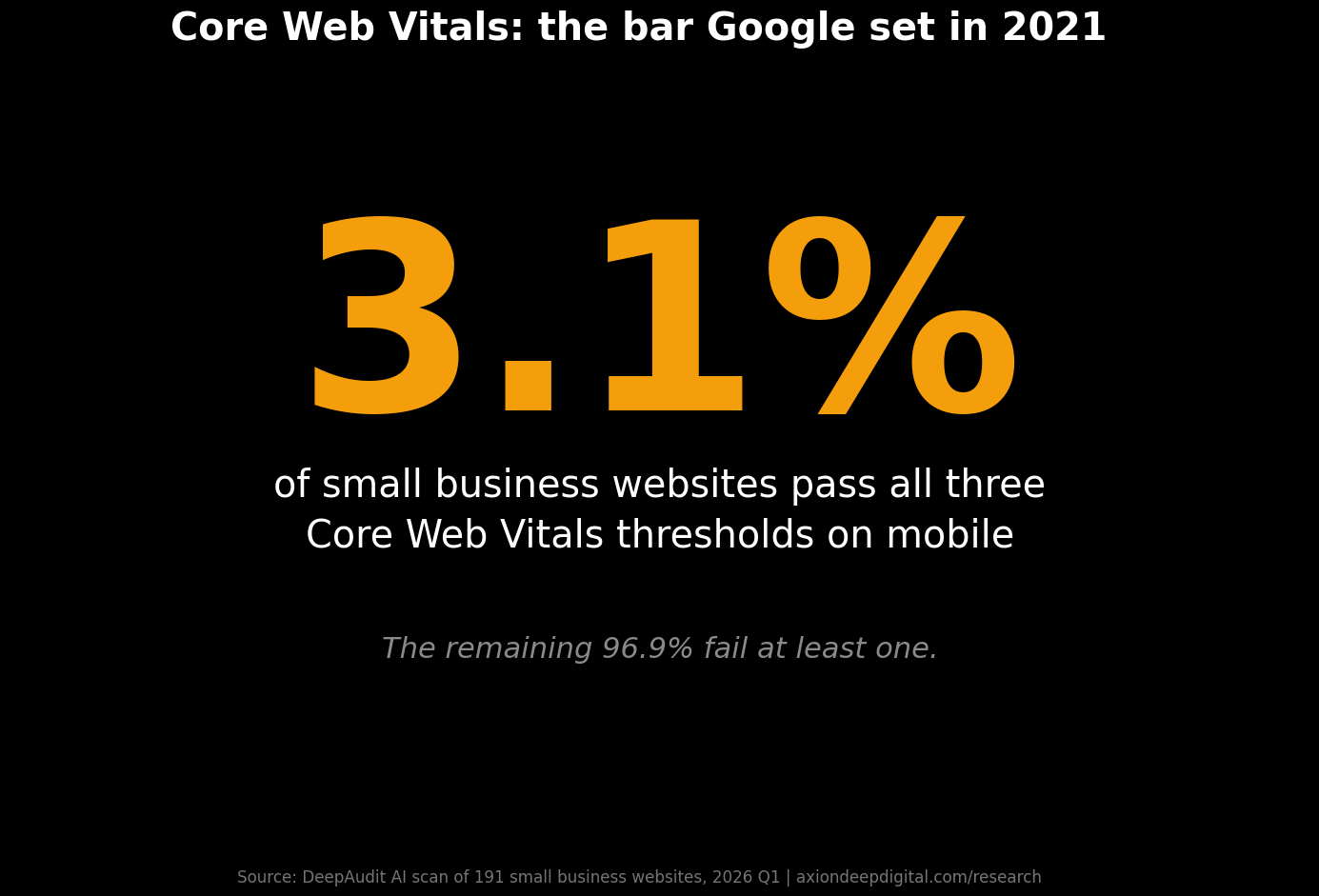
But aggregated like that, the number is a blunt instrument. It says most sites are slow without saying how. The useful finding is underneath: the failure is specifically about time to first content, not layout stability.
Core Web Vitals is three metrics:
- Largest Contentful Paint (LCP): how long until the biggest visible element finishes rendering. Good: under 2.5s. Poor: over 4s.
- First Contentful Paint (FCP): how long until the first pixel of content appears. Good: under 1.8s. Poor: over 3s.
- Cumulative Layout Shift (CLS): how much content jumps around during load. Good: 0.1 or below. Poor: over 0.25.
Across the 191 sites with valid mobile Lighthouse data:
- 86.4% of sites post poor LCP. Only 5.2% are good.
- 72.4% of sites post poor FCP. Only 5.2% are good.
- 85.5% of sites pass CLS. Only 4.7% post poor CLS.
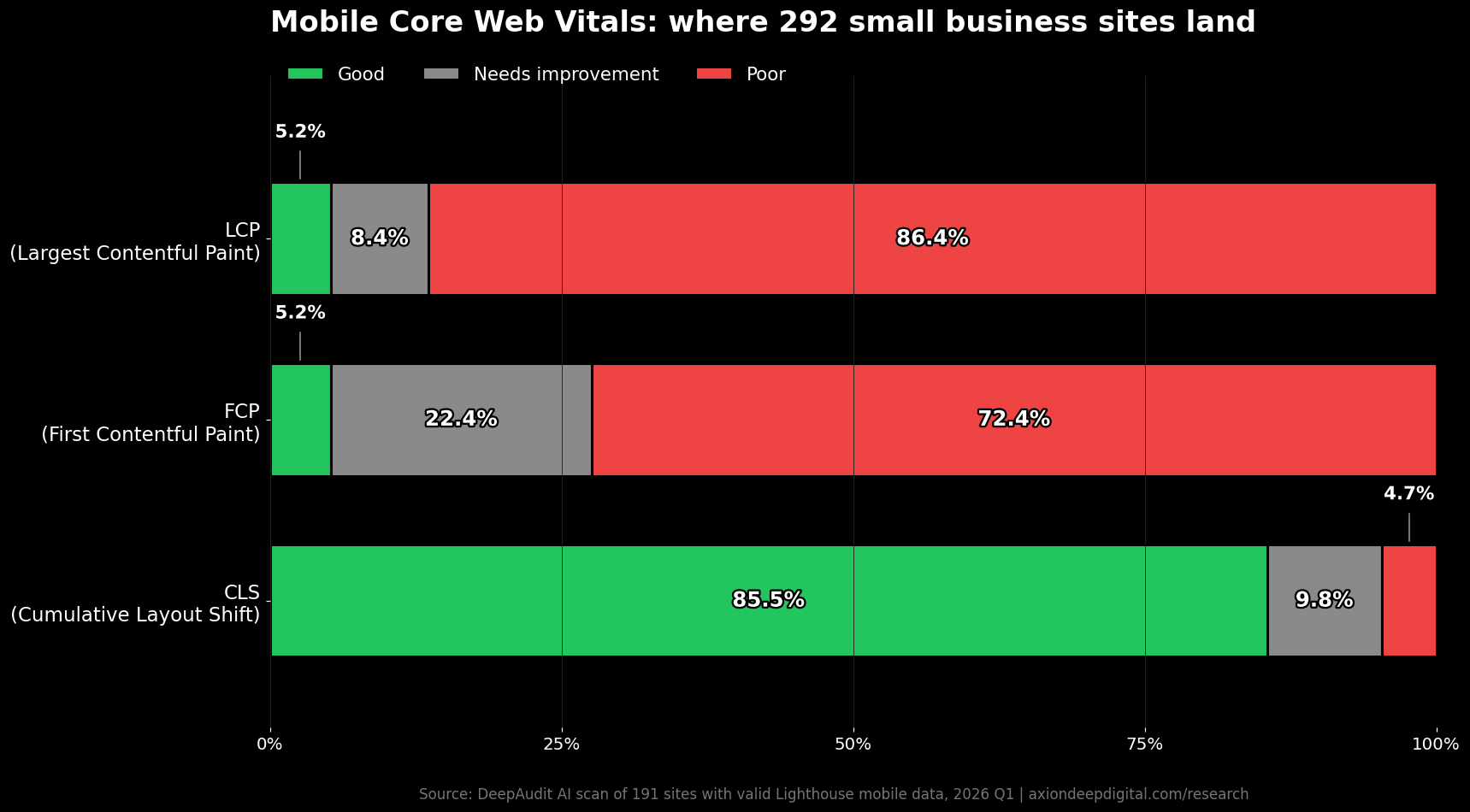
Read that column in order. The two metrics that measure how long the user stares at an empty or half-rendered screen are where small business websites fail overwhelmingly. The metric that measures whether content jumps around after it appears is where they almost all pass. This is not a performance problem in general. It is a time-to-first-content problem.
That framing narrows the list of likely causes. Layout shift is usually caused by images without dimensions, late-loading ads, or web fonts swapping in. First paint latency on mobile is caused by something else: the browser cannot render until it has downloaded and executed enough of the page to know what to draw. The short list of causes:
- Unoptimized hero images. A 2 MB JPEG above the fold is the single most common LCP killer.
- Render-blocking JavaScript. Any
<script>tag in the head withoutdeferorasynchalts parsing until the script downloads and executes. - Render-blocking CSS. Large CSS bundles served without preload hints block first paint by the full duration of the CSS download.
- Missing
<link rel="preconnect">hints. Third-party domains each add a TCP + TLS handshake round trip. - No image lazy loading. Below-the-fold images compete with hero assets for bandwidth.
- Oversized web fonts. A custom font served synchronously from the head delays first paint by the full font download.
Every item in that list is fixable in a week of focused development work. None of them require a rewrite, a new framework, or a budget over five figures. They are practices every senior web developer knows and that no small business's first WordPress theme shipped with.
The fact that 86.4% of small business websites ship with at least one of them explains the first-paint failure more than any broader "the web is slow" narrative does.
Finding 2: Mobile is treated as an afterthought, and the data shows it
For the 165 sites where we have paired mobile and desktop Lighthouse runs, desktop performance beats mobile by a median of 22 points. 55.8% of sites show a 20-point or larger gap. 26.7% show a 30-point or larger gap.
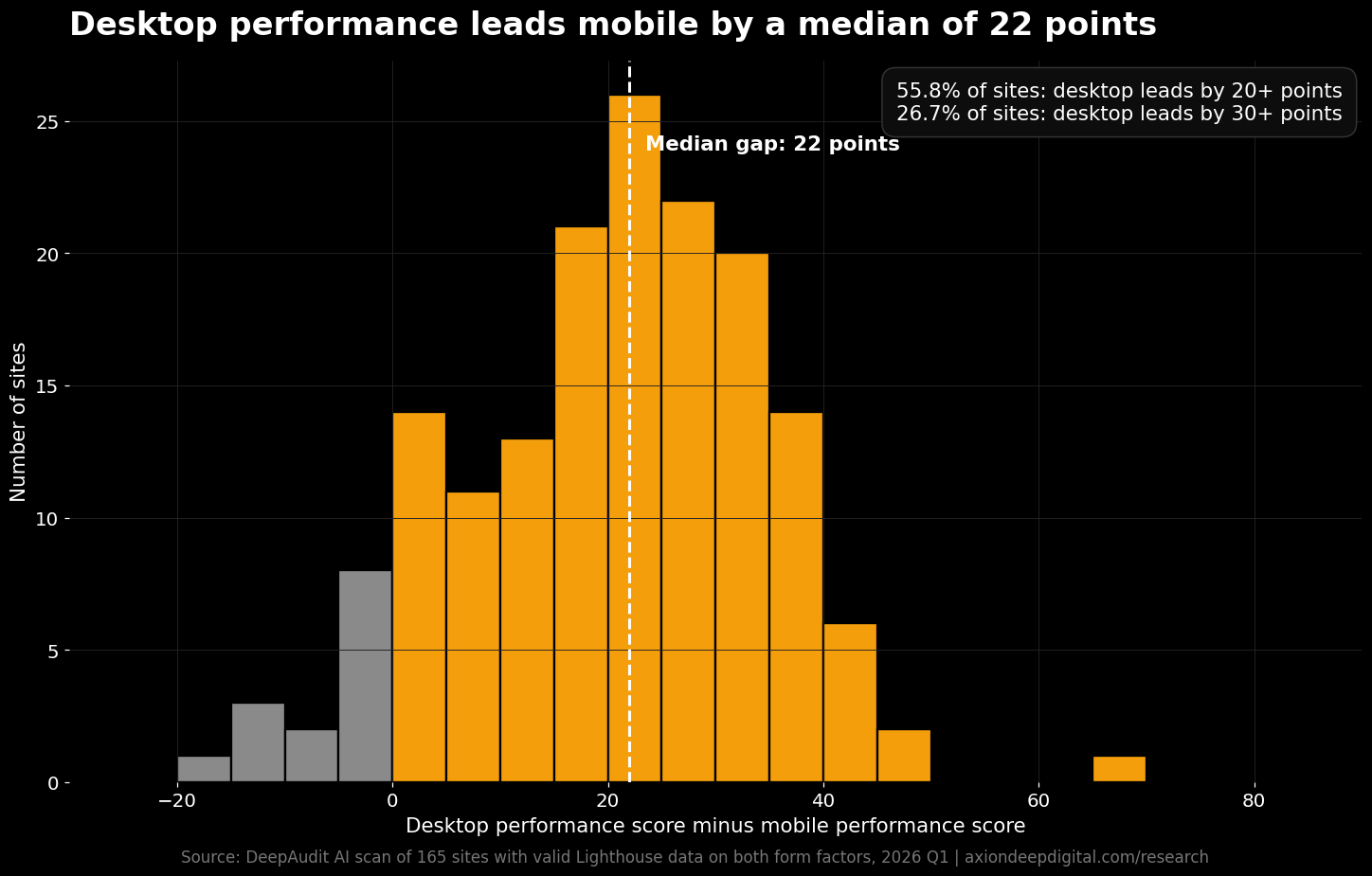
This is not a story about mobile hardware being slower than desktop. Lighthouse's mobile configuration simulates a mid-tier 2023 Android phone on a slow 4G connection. That is a reasonable proxy for what a real user sees. If a site performs worse on that profile than on a simulated desktop with a fiber connection, the site has an optimization gap, not a user gap.
A 22-point median performance gap on the same codebase means the site's assets (hero images, JS bundles, CSS, fonts) were not sized and optimized for the mobile form factor. Desktop has enough bandwidth and parsing speed to tolerate unoptimized assets; mobile does not. That 22-point gap is the cost of shipping desktop-first assets to mobile users.
For small businesses this is the expensive mistake hidden in plain sight. For most small businesses with local and consumer-facing audiences, mobile is the majority channel, not a secondary one.
The 22-point gap means the majority of incoming visitors are being served a slower experience than the form factor the site was actually optimized for.
Optimizing for desktop first and accepting a 22-point drop on mobile means shipping the lower-performing build to the larger audience.
Finding 3: 100% of evaluated sites failed the Link Labels accessibility check
Of the 191 sites where axe-core returned a valid evaluation, 191 failed the Link Labels check. Every single one.
What Link Labels is
The Link Labels check fires when a link's accessible name (what a screen reader announces) is missing, empty, or meaningless. Common patterns that fail:
- An icon-only link (
<a href="/cart"><svg>...</svg></a>) with noaria-labeland no visually hidden text - A "Read more" link that appears dozens of times on a page with no context
- A decorative image link where the image has
alt=""and the link has no other text - A link whose only content is an emoji or a unicode arrow symbol
When a screen reader encounters these, it announces "link" followed by the URL, or nothing at all. A blind user navigating by tabbing hears "link, slash page one, link, slash page two, link, slash page three" with no context for what each link goes to. The page is functionally unusable.
Why it fails at 100%
Link Labels failing universally is the most unexpected finding in this report, and we checked it three ways to confirm the result is not a measurement artifact. It is not. The CSV (check_link_labels column) shows 191 fail rows and zero pass rows. Anyone can replicate the result by running axe-core in headless Chrome against the same sites.
The explanation is that every site in the sample shares at least one ubiquitous pattern that fails the check. The most common culprit: social media icon links in headers and footers. An Instagram logo linking to an Instagram profile, with no aria-label and no visually hidden text, is a Link Labels failure. It is also something virtually every small business website has.
The fix for any of these is one line of HTML. Add aria-label="Visit our Instagram page" to the icon link. Add a visually hidden <span> to each "Read more." The fact that 191 out of 191 sites failed to do this for at least one link on their homepage is the story.
It is not a story about hostile design or budget constraints. It is a story about the WCAG layer being invisible to the people who build and maintain small business websites.
The practical stakes
ADA-related web accessibility lawsuits against US businesses have climbed each year since 2018, tracked publicly in UsableNet's annual Digital Accessibility Lawsuit Report. A growing share of those filings are template-based demand letters targeting the exact axe-core failures that ship in ready-made themes.
Link Labels is on the standard template list. Settlement costs for small businesses routinely reach five figures. The cost of the fix is a few hours of developer time. The cost of ignoring it is not theoretical.
Finding 4: Structured data and heading hierarchy are missing at scale
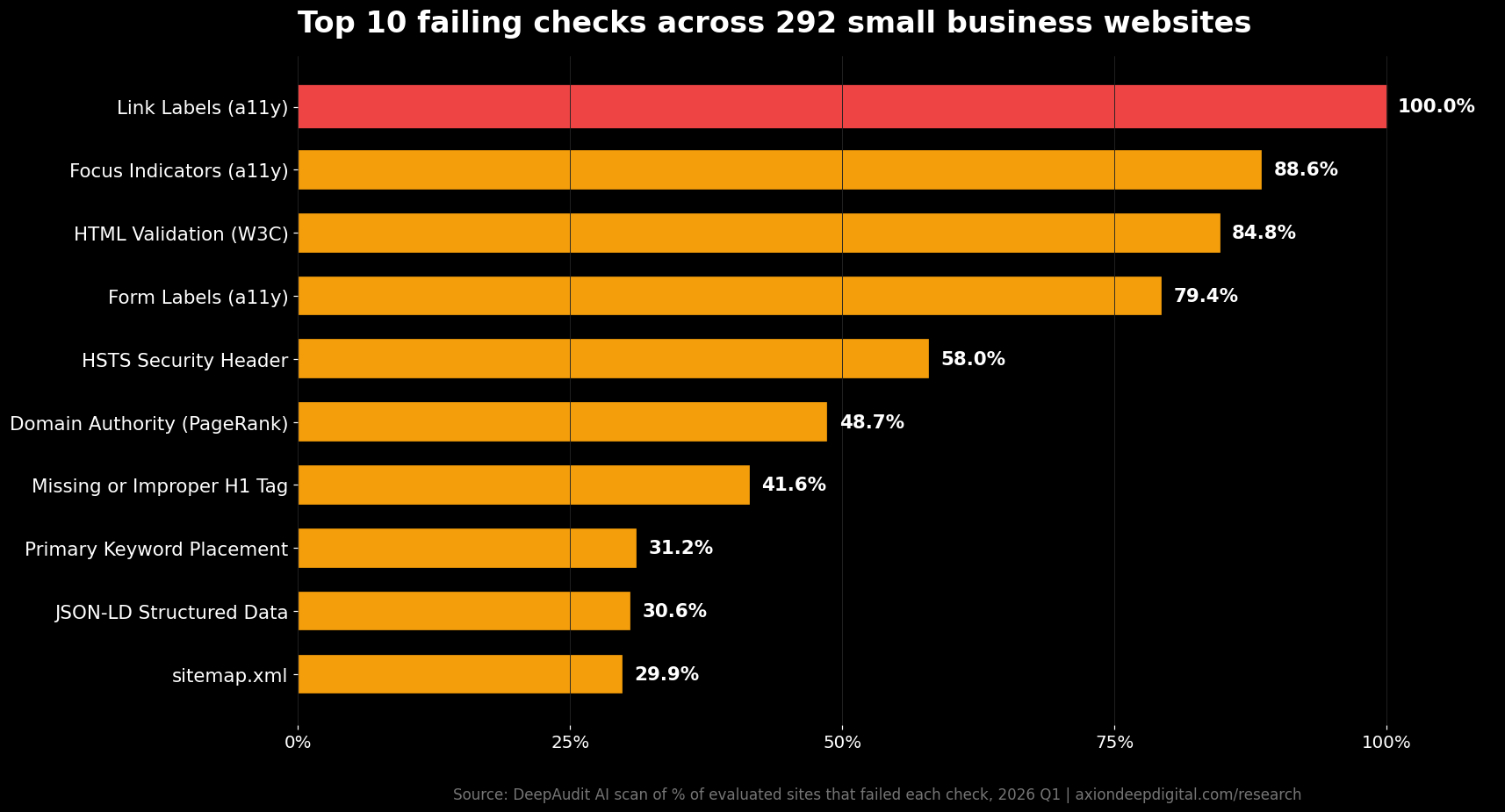
A rich snippet in Google search results is not optional anymore for competitive keywords. Review stars, pricing, FAQ expanders, breadcrumb navigation, and event details all require JSON-LD structured data on the page. Across the 292 sites:
- 30.6% of sites have no JSON-LD structured data at all.
- 41.6% of sites are missing a proper H1 tag (absent, empty, or duplicated).
- 21.5% of sites fail at least one heading-hierarchy check.
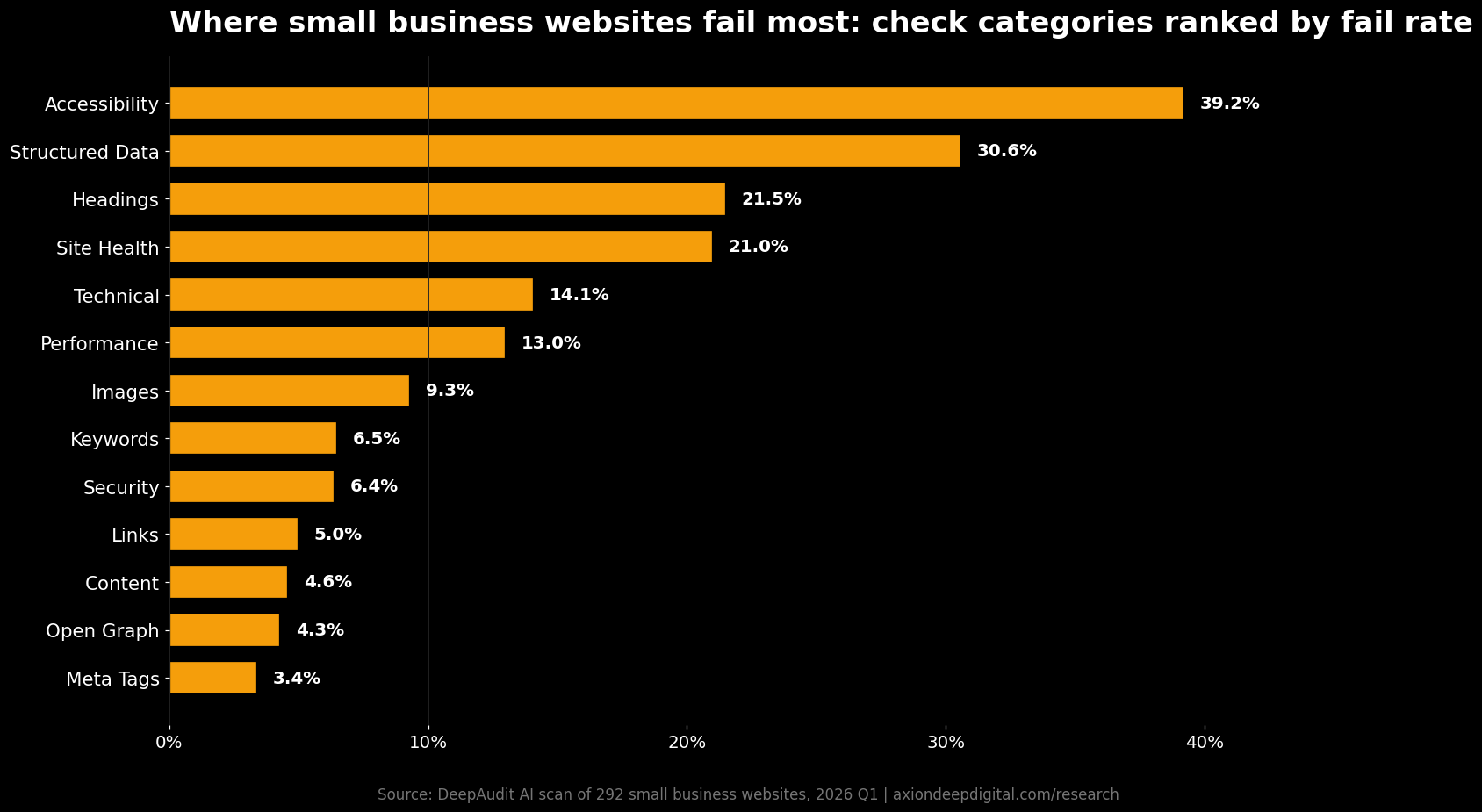
Each is a small problem in isolation. Together they form the shape of the content layer in most small business websites: content that exists but is not marked up so machines can parse it. A page without Organization schema cannot render a knowledge panel.
A page without Product schema cannot show a price in search results. Search results for queries where competitors have rich snippets and you do not are a sorting problem: you appear lower than sites with richer SERP presentations even when your content is better. A competent developer can add schema markup in one to three days depending on page count.
Finding 5: The authority floor most small business SEO advice ignores
Across the 260 domains with valid Open PageRank data, 74.6% have Open PageRank below 3 on a 10-point scale. The median is 2.54. Only 3.5% of domains have a PageRank above 4.
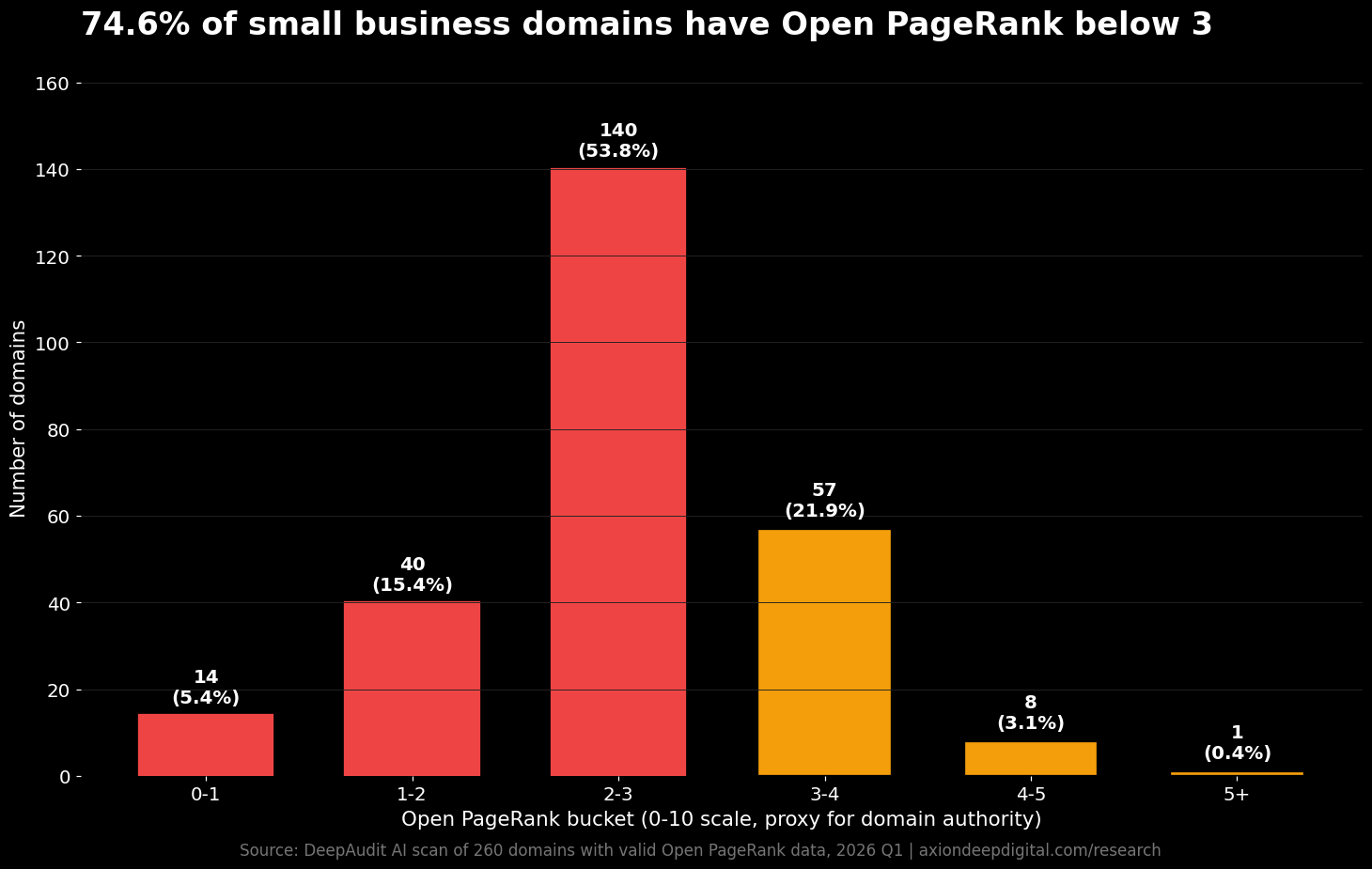
Open PageRank is not Google's internal PageRank (retired in 2016). It is a public proxy computed from Common Crawl link data. It is directionally useful, not authoritative. But the distribution is consistent with what every DA-tracking tool reports: the long tail of small business domains sits at the bottom of the authority curve.
What this means practically:
- Authority-based SEO strategies have diminishing returns at the low end. Moving from PageRank 2 to PageRank 3 is many months of sustained work for a small business.
- Technical and content strategies compound better at the low end. A site at PageRank 2 that ships fast, accessible, structured pages outranks a site at PageRank 2.5 that does not.
- The Fortune 500 cannot be outranked on authority. What small businesses can do is occupy the long-tail search space that large brands do not write targeted content for.
Every agency pitch that leads with "we will build you backlinks" is fighting for a small delta at the bottom of the curve. Every agency that ships a mobile-fast, fully schema-marked-up, accessible site is giving a small business a structural edge that compounds.
What this means for small businesses
Rolling up the five findings:
- Mobile performance is broken. Cause: unoptimized assets served identically to mobile and desktop. Fix: image optimization, defer/async scripts, preconnect hints, lazy loading. One to two weeks of developer work.
- Accessibility is broken at 100%. Cause: the WCAG layer is invisible to the people who built the site. Fix: axe-core in CI, aria-label on every icon link, skip links, focus indicators. Days.
- Structured data is missing on a third of sites. Fix: Organization, LocalBusiness, Product, Article, FAQPage schema applied per page type. Two to three days.
- Heading hierarchy is broken on 42%. Fix: one H1 per page, no skipped levels, semantic structure. Hours.
- Authority is low and will remain low. Compete on page quality, speed, accessibility, and content depth.
A business that fixes the first four items inside a single quarter ends up with a site that outperforms 95%+ of its competitors on the criteria Google uses to rank. That is not a marginal gain. It is a structural reordering of who ranks first for any given small business keyword in a given metro.
Verify your own site
The free audit tool at axiondeepdigital.com/free-seo-audit runs the same DeepAudit pipeline that produced this dataset. No signup. 60-second scan. Every finding in this report becomes a specific, line-numbered fix for your site.
Run a free audit →About this research
Axion Deep Digital is a web development and technical SEO agency based in Las Cruces, New Mexico and working remote-first with clients across the US. DeepAudit AI is our proprietary audit tool, built to render pages the way Google does rather than parse static HTML.
This report is the first in a planned annual series. Methodology, dataset, and code are public. We expect to repeat the scan in Q1 2027 with an expanded sample and track year-over-year movement on each finding.
Questions, corrections, and collaboration inquiries: support@axiondeepdigital.com.
Citation
Data and reproducibility
- state-of-sbw-2026-dataset.csv (CC BY 4.0, 292 rows, 41 columns)
- Archived on Zenodo with a citable DOI: 10.5281/zenodo.21312250
- Also mirrored on Hugging Face and Kaggle
- Methodology & dataset schema : full column definitions, anonymization procedure, caveats
Axion Deep Digital is an operating subsidiary of Axion Deep Labs, Inc. (NM), an independent research and technology holding company. No external funding supported this research.