Axion Deep Digital Research / July 2026
We checked 556 CPA firm websites. 94% can't prove a single expert to an AI.
A CPA firm's whole value is human expertise: who handles equity comp, trusts, expat tax. An AI assistant can only surface that expert if the site publishes it as machine-readable fact. Almost none do.

The numbers that define this report
publish no Person schema, so no named expert is legible to a machine. 437 of 464 reachable firms (95% CI 91.7–96.0).
have no identity schema at all, not even an Organization or AccountingService block naming the firm.
block any AI crawler. Invisibility here is a markup problem, not a blocking one. The firms are not shutting AI out; they are handing it a blank page.
have an llms.txt file, which looks like broad adoption of the new AI-agent standard.
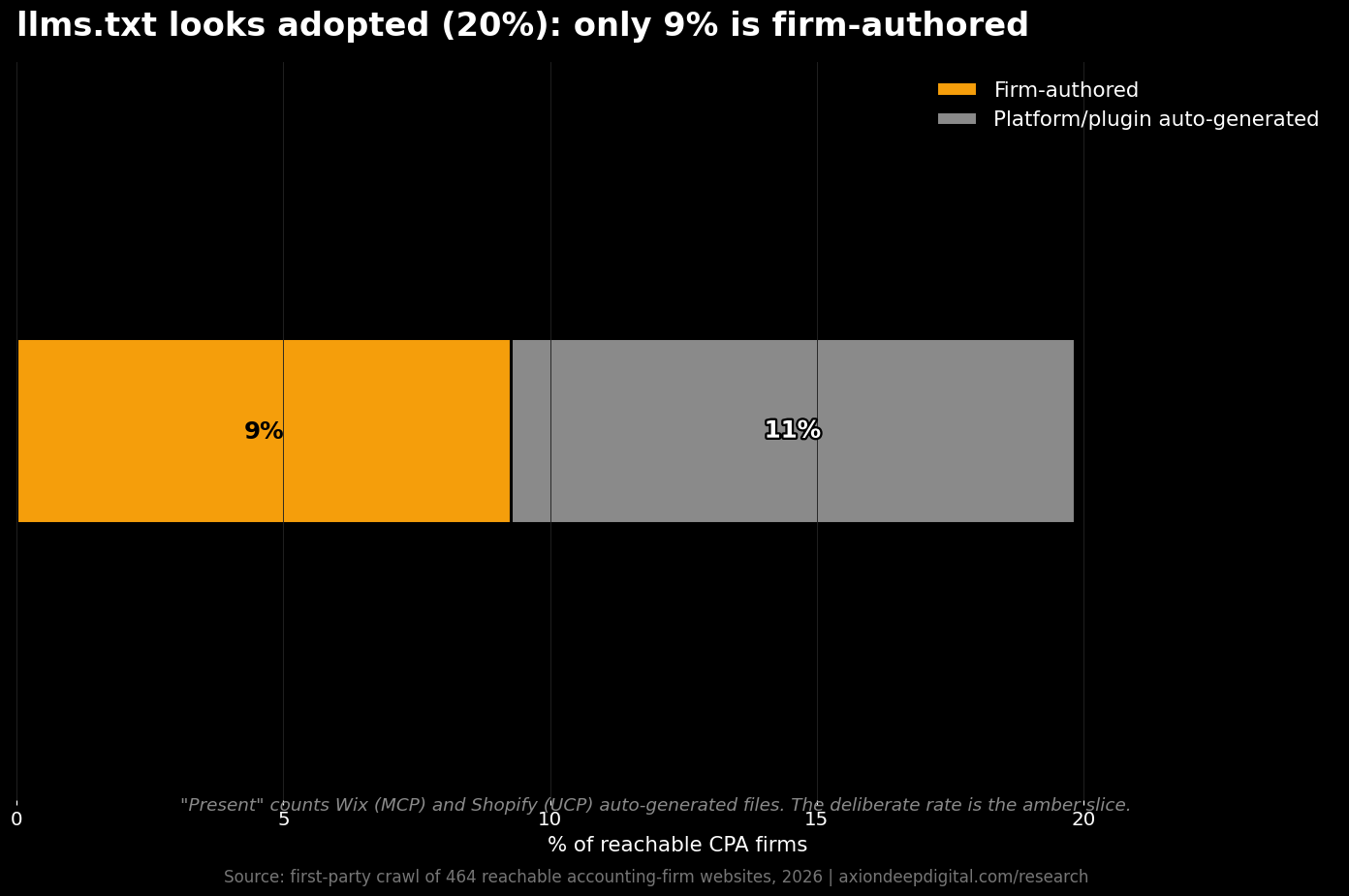
wrote one on purpose. The rest is auto-generated by Wix, Shopify, or an SEO plugin. Fewer than one firm in ten made a deliberate choice.
Open data, open methodology.
556-row dataset. Anonymized. CC BY 4.0. Every measured flag included.
What we measured (and what we did not)
This study measures structured-data legibility, not firm quality. A firm with no Person schema can be excellent. It is simply invisible to a machine in the one way that decides whether an AI assistant can recommend it for a specific need. We looked at each firm's homepage, its robots.txt, and its llms.txt, and recorded which machine-readable signals were present. Every figure is descriptive. We make no causal claims.
The signal that matters most for this vertical is Person schema: the JSON-LD markup that connects a named human to a role and an area of expertise. For most local businesses, "who is a good one" is answered by proximity and reviews. For a CPA firm it is answered by expertise, and expertise lives in people. If the site never states, in machine-readable form, that a named partner handles equity compensation or expat tax, an answer engine has nothing to connect a question to.
The headline: the expert nobody can prove
Across 464 reachable firms, 94.2% published no Person schema at all (95% CI 91.7–96.0). A small-sample pilot of 27 firms earlier this year found zero. We deliberately did not publish that number, because zero out of 27 is fragile. At scale the honest figure is that 5.8% do mark up a named expert, and about nineteen in twenty do not. That is still one of the most lopsided adoption gaps we have measured, and it sits in the exact vertical where a named expert is the product.
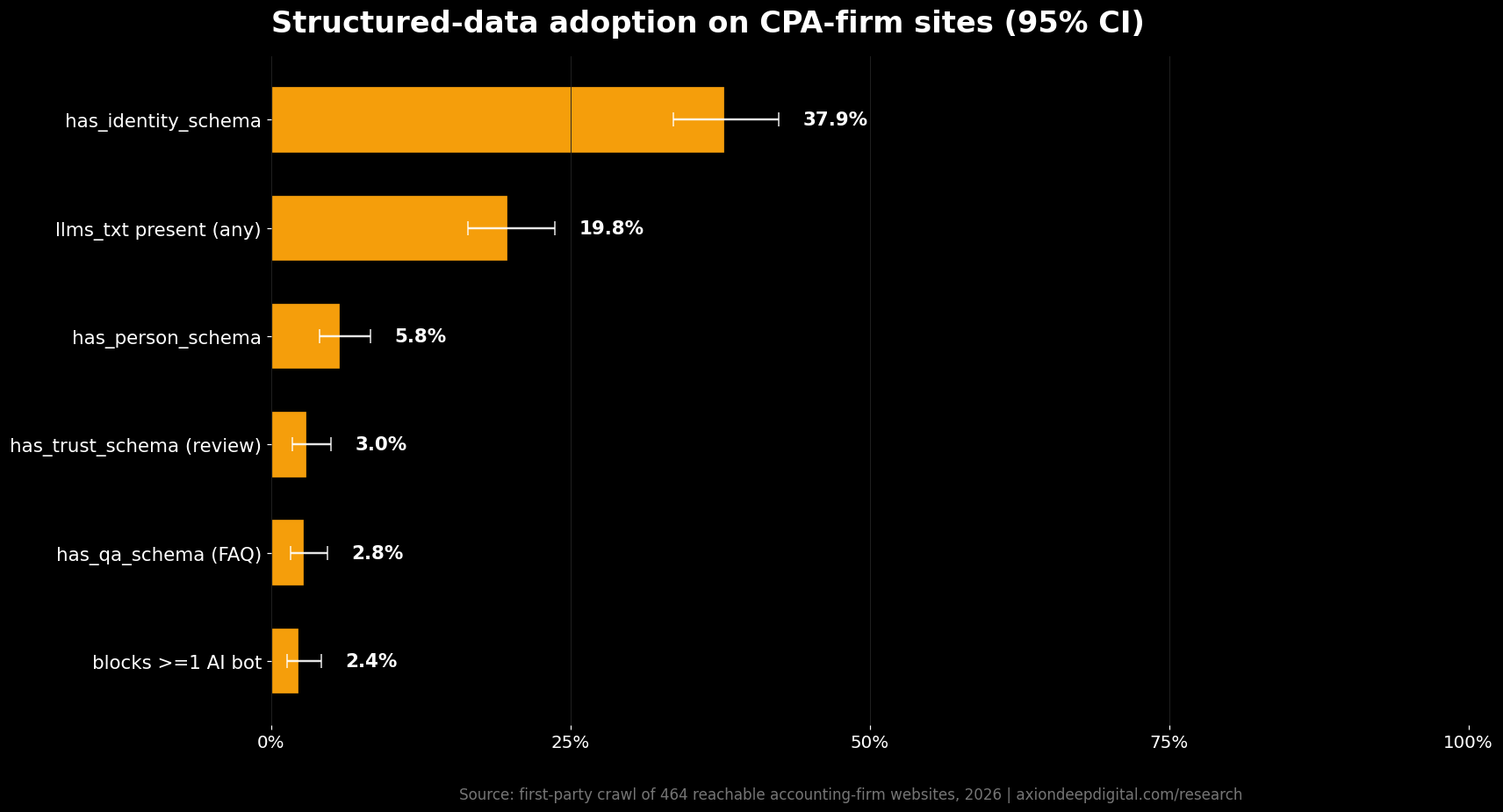
Identity schema, the baseline block that names the organization, was present on only 37.9% (95% CI 33.6–42.4). FAQ schema, the answer-shaped structure AI readily extracts, was on 2.8%. These are the honest levers a firm can pull, and almost none have.
The llms.txt mirage
One number looked encouraging at first: 19.8% of firms had an llms.txt, the emerging file that tells AI agents how to read a site. One in five would be surprisingly high adoption for a standard this new. It is not what it looks like.
When we classified who actually wrote each file, only 9.3% were firm-authored. The rest were generated automatically by the platform: Wix now emits an llms.txt advertising a Model Context Protocol endpoint, Shopify emits one for its commerce protocol, and SEO plugins like All in One SEO produce their own. Counting those as deliberate AI-readiness would overstate it by more than double. The honest read is that fewer than one CPA firm in ten has chosen to publish an llms.txt.
It is not a blocking problem
A natural question is whether these firms are deliberately keeping AI out. They are not. Only 2.4% block any AI crawler in robots.txt (95% CI 1.3–4.2). The doors are open; there is just nothing structured on the other side to read. Invisibility here is a markup problem, and markup is fixable.
Every signal we measured
Share of the 464 reachable firms with each machine-readable signal, with Wilson 95% confidence intervals.
| Signal | Present | 95% CI |
|---|---|---|
| Identity schema (Organization / LocalBusiness / AccountingService) | 37.9% | 33.6–42.4 |
| llms.txt present (any provenance) | 19.8% | 16.5–23.7 |
| llms.txt firm-authored (not platform-generated) | 9.3% | 7.0–12.3 |
| Person schema (a named expert) | 5.8% | 4.0–8.3 |
| Review / rating schema | 3.0% | 1.8–5.0 |
| FAQ / Q&A schema | 2.8% | 1.6–4.7 |
| Blocks at least one AI crawler | 2.4% | 1.3–4.2 |
On review markup: only 3.0% of firms use Review or AggregateRating schema, and we do not recommend adding it. Google's guidelines disallow self-serving review markup that a business applies to itself. The honest, policy-safe levers here are Person, identity, and FAQ schema, the ones almost no firm is using.
By metro size
We stratified the sample by metro size. The gap is consistent everywhere: Person schema stays in single digits across every stratum, and identity schema hovers around a third.
Read these as directional point estimates, not precise splits. The per-stratum samples are smaller, and metros were sampled with overlapping geographic bounds.
| Stratum | Firms (n) | Person | Identity |
|---|---|---|---|
| Major metros | 191 | 8% | 38% |
| Tech hubs | 104 | 5% | 38% |
| Mid-size metros | 140 | 4% | 39% |
| Small metros | 29 | 3% | 31% |
What they are built on
Detected platform across the reachable firms. WordPress and hand-coded or unidentified builds dominate, which is typical of an established professional-services vertical.
| Platform | Firms (n) |
|---|---|
| Unknown / hand-coded | 181 |
| WordPress | 159 |
| Wix | 32 |
| GoDaddy | 27 |
| Squarespace | 16 |
| ASP.NET | 14 |
| Drupal | 7 |
| PHP / other | 7 |
Methodology
We drew the sample from OpenStreetMap, taking businesses tagged office=accountant or office=tax_advisor that carried a website, across 68 US metros stratified into major, tech hub, mid-size, and small. That yielded 556 unique firm domains. We fetched each firm's homepage, robots.txt, and llms.txt on a single pass and parsed the machine-readable signals; raw HTML is not redistributed.
All adoption statistics are computed over the 464 reachable firms (a homepage returning HTTP 200 with a non-empty body), 83.5% of the sample. The 92 unreachable domains (dead sites, timeouts, bot blocks) are reported, not imputed. Every proportion carries a Wilson score 95% confidence interval, which stays well-behaved near 0%, where the interesting numbers here sit.
Four hypotheses were pre-registered before this confirmatory crawl: a majority of firms lack Person schema (supported), a majority lack identity schema (supported), FAQ schema and llms.txt are each rare below 15% (not supported, because llms.txt reached 19.8%), and AI-crawler blocking is rare below 10% (supported). We report the llms.txt result exactly as pre-registered, and the firm-authored split as a labeled follow-up analysis rather than a redefinition of the original test.
This is a purposive sample, not a random one. It is drawn from firms that OpenStreetMap records with a website, so it skews toward established, findable practices and is not representative of every US accounting firm. Findings describe this population. The study measures machine-readable structure, not firm quality and not whether an AI ultimately recommends a given firm.
Why it matters
When a prospect asks an assistant "who is a good CPA for startup equity comp near me," the assistant needs a machine-readable link between a person, a place, and a specialty. The firms that publish that link are eligible to be named. The 94% that do not are, for this kind of query, invisible, regardless of how good they actually are. The fix is not more content or a redesign. It is a block of structured data that states, in the HTML the server sends, who each expert is and what they do.
Open dataset
The full per-firm dataset, metro stratum, detected platform, reachability, every schema flag, and llms.txt presence and provenance, is released under CC BY 4.0. It is anonymized at row level (domain and city removed) so no individual firm is singled out. Journalists and researchers may reproduce or cut their own angles with attribution.
State of CPA Firm Websites 2026 Dataset
556 rows · CSV · CC BY 4.0 · anonymized
Cite this dataset
Joshua R. Gutierrez. (2026). The State of CPA Firm Websites 2026: Structured-Data and AI-Legibility Dataset (n=556) (Version 1.0.0) [Dataset]. Zenodo.
DOI: 10.5281/zenodo.21311716Also mirrored on Hugging Face and Kaggle.
Can an AI name your experts?
DeepAudit AI renders your site in a real browser and checks the structured data an answer engine reads, including whether your people are machine-legible. Free, no signup, results in about 60 seconds.
Run a Free DeepAudit AI Scan