The Second Reading
We owed you this one
At the end of Issue 8, we made a promise.
Instead of showing another handful of screenshots, we said we would start publishing an actual dataset: the same questions, asked on a schedule, with the results reported whether they improved or not.
Then Issue 9 became an article about Ahrefs instead.
So this is the issue we owed you.
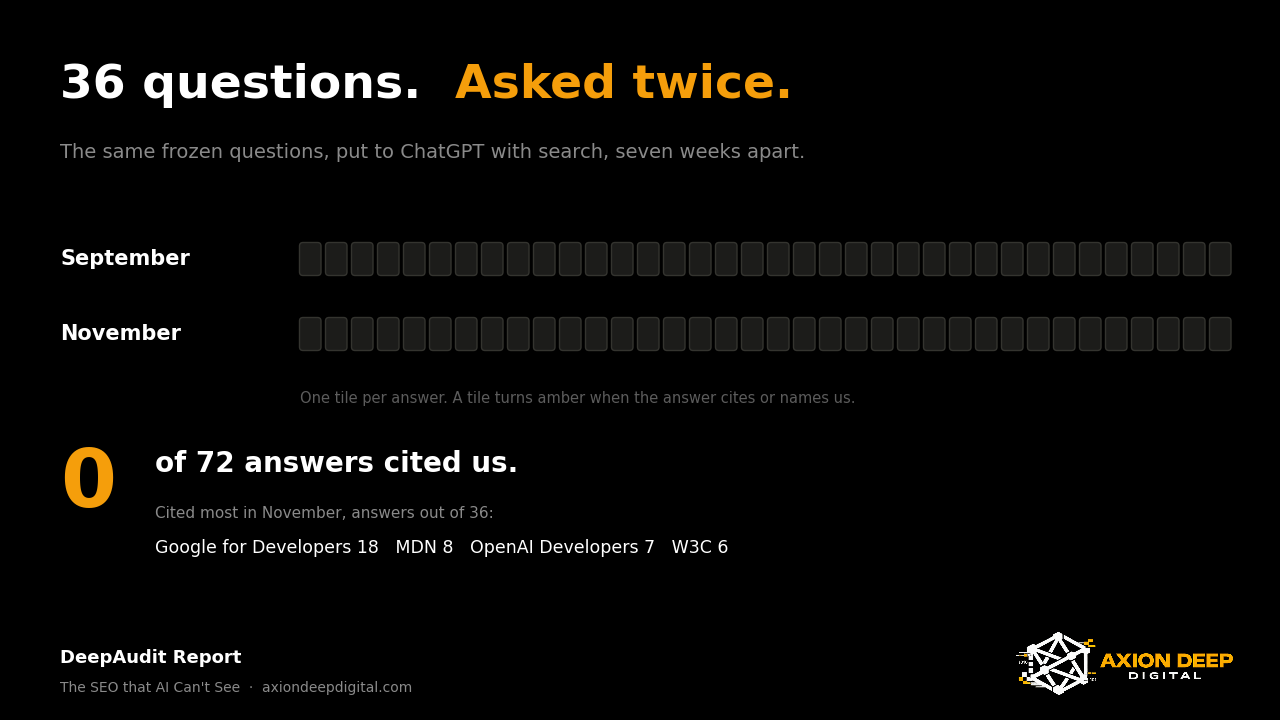
The short version is simple. We asked ChatGPT 36 questions in September, then asked the exact same 36 again in November. We have pages on our site that answer every one of them.
In September, ChatGPT cited us zero times. That wasn't surprising. The pages had only just been published.
Seven weeks later, it cited us zero times again.
That was the part we were hoping would change.
What we measured
In September, we published twelve short lessons on our website.
Six cover fairly standard technical SEO topics, including title tags, canonical URLs and alt text. The other six focus on AI visibility: things like whether AI crawlers can read JavaScript, what llms.txt is supposed to do, and how assistants choose the sources they cite.
Before the first lesson went live, we wrote 36 questions, three for each lesson, and froze them.
None of the questions include our company name, and none were written in a way that tries to lead the assistant toward our answer. We also hashed both question sets so we couldn't quietly change the wording later and pretend it had always been that way.
The rules were fixed too.
We used ChatGPT with search turned on. Every question started in a fresh conversation. There were no follow-up prompts and no account memory involved in the test. Each answer was placed into one of five buckets, ranging from "cited the exact lesson" to "no appearance."
The first run happened on September 17 and 19, the same days the lessons were published.
All 36 answers came back as "no appearance."
At that point, the zero didn't mean much. The pages were only hours old.
The second reading
We ran the same 36 questions again on November 6.
By then, the lessons had been live for between 48 and 51 days.
| Outcome | September | November |
|---|---|---|
| Cited the exact lesson | 0 | 0 |
| Cited another page on our site | 0 | 0 |
| Cited the lesson video | 0 | 0 |
| Named us without a link | 0 | 0 |
| No appearance | 36 | 36 |
So, once again, 36 out of 36.
No link to our site. No mention of our name.
There are two details about this second run that matter.
First, our original plan called for another measurement at 30 days. We missed it. This reading happened at about seven weeks instead of four.
Second, two of the 36 questions had to be sent a second time because the capture process failed after the answers were returned but before anyone read or saved them. Nobody saw the first answers, so they weren't selectively rerun, but the protocol did say no reruns. We recorded the failure instead of pretending it didn't happen.
What ChatGPT cited instead
The zero itself isn't the most interesting part.
The more useful question is: if it didn't cite us, who did it cite?
For the 18 technical SEO questions, every answer included at least one source.
Thirteen of those 18 answers cited only documentation or standards material. MDN appeared on 8 answers. Google's developer documentation appeared on 8. The W3C appeared on 6, and the HTML standard appeared on 2.
Commercial sources showed up on only 2 of the 18 answers. One was an SEO plugin company and the other was an SEO software company. In both cases, they appeared alongside Google documentation.
That makes a certain amount of sense.
Ask ChatGPT what a canonical tag is, and it tends to go to the people who define how canonical tags work.
The same pattern showed up even more clearly in the AI visibility questions.
All 18 answers included sources, and 14 of the 18 cited the companies behind the platforms themselves. Google's documentation appeared on 10 answers. OpenAI appeared on 9. Bing appeared on 6, and Anthropic appeared on 3.
In other words, when someone asks ChatGPT how AI assistants work, ChatGPT often answers using material published by the companies building those systems.
The part that stung
This is where the two readings became more interesting.
Back in September, 18 of the 36 answers didn't cite anyone.
At the time, we saw those uncited answers as open ground. If an assistant was answering a question without linking to a source, maybe a useful, well-built page could eventually become that source.
By November, that open ground was gone.
Every one of the 36 answers now included a source.
None of those new citations went to us.
We can't say why that changed, and we don't want to pretend that we can.
Seven weeks of product changes happened between the two readings. The model may not have been the same. The September run was done while signed out, while the November run was done while signed in with personalization turned off. The first set of questions was typed manually, while the second was loaded by link with search enabled.
Any one of those differences could matter.
So we're not claiming that ChatGPT suddenly "started citing more."
We're only reporting what happened in these two runs.
On the technical questions, the new citations largely went to MDN, the W3C and the HTML standard.
The AI visibility questions were a little more interesting.
Three of the 18 answers cited smaller sites outside the usual documentation and industry publications. We looked at what those sites actually were.
One is a free scanner built by a single developer that checks whether AI crawlers can read a page. Another is a reference site focused entirely on llms.txt, with its own generator and validator. Two are subscription software products. The fifth is a marketing platform operated by an agency.
We only recorded the domains that were cited, not the exact pages, so we can't say which specific piece of content earned each link.
What we can say is that four of those five sites are built around software that actually does something. The fifth is a tightly focused reference site that also provides its own tools.
That's only three answers out of 18, so we're not calling it a finding.
But it is enough to give us something worth testing.
Because what we built was different.
We built lessons.
We also checked whether the zero was our own fault
Before treating a zero as meaningful, we wanted to make sure the pages were actually available to be cited.
All twelve lessons are in our sitemap. Every one is marked as indexable and uses a self-referencing canonical.
Our robots file allows the major AI crawlers we checked.
We also requested lesson pages using several different user agents: a normal browser, OpenAI's search crawler, GPTBot and Bingbot.
The server returned the same page every time, byte for byte, and the content didn't depend on JavaScript to appear.
That rules out some of the easy explanations.
We also checked Bing Webmaster Tools.
All thirteen Learn URLs, the main hub plus the twelve lessons, are indexed with no reported errors.
That tells us they exist in at least one major search index. It does not tell us which index ChatGPT used for any particular answer.
Then Bing showed us something we weren't expecting.
Its AI Performance report tracks citations from Microsoft's Copilot and partner assistants. Between August 6 and November 3, it recorded 87 citations to our site across 14 URLs.
One of those URLs is our H1 tags lesson, which Bing says was cited 6 times.
Bing describes that report as a sample, and it doesn't show us the questions that caused those citations, so there are limits to what we can conclude from it.
But it changes the meaning of the zero.
The result in this article belongs to one assistant and one fixed set of 36 questions.
It does not mean that no AI assistant has ever cited one of our lessons.
The other long-running measurement
We have another experiment that has been moving much more slowly.
In Issue 7, we wrote about claiming our profile on a large agency directory. Sixteen days later, we still hadn't appeared on its ranked list of SEO companies in New Mexico.
At sixteen days, it was fair to say we probably hadn't waited long enough.
It has now been 104 days.
The list has grown from 126 companies to 135, and from four pages to five.
We're still not on it.
Our profile is live. It has a review. Search engine optimization is listed as our largest service line.
Meanwhile, three agencies in our own city appear on the first page with no reviews at all.
We still don't know what determines who gets included because the directory doesn't publish that information.
What we do know is that claiming the profile, completing it, and waiting three and a half months wasn't enough.
What we did not measure
There are a few limits here that are worth stating plainly.
We did not rerun the Google search measurement from Issues 5 through 8. The browser available for this round was signed in, and we've already learned what happens when we treat a signed-in result like a clean measurement.
This experiment also covers one assistant.
It tells us nothing about what Gemini, Perplexity or Google's AI results might cite.
It also covers 36 questions in our own area of work.
That doesn't tell us what happens when somebody asks an assistant to recommend a plumber, an accountant or a restaurant.
And two readings are not a trend.
They're two readings.
What we take from it
If your AI visibility strategy is simply "publish more explanations," this dataset gives you a pretty clear picture of the competition.
For definition and how-to questions, the assistant we tested repeatedly went back to standards bodies, browser documentation and the platforms' own guidance.
That means an agency article explaining a technical concept isn't only competing with other agency articles.
Sometimes it's competing with the W3C.
The handful of smaller independent sites that did earn citations were interesting for a different reason. Most of them were built around a tool or a product, something the official documentation doesn't provide.
Three answers out of 18 isn't enough to turn that into a rule.
It is enough to test the idea.
We have a free audit tool of our own, and none of these 36 questions were designed to reach it.
So that's one of the next things we want to measure.
The next scheduled reading is due between November 15 and 18, when these lessons reach 60 days.
We'll run the same questions again.
And if the answer is still zero, we'll publish zero again.
If you want to know what AI says about your business
There are still two ways to do that.
The free option is manual.
Send us your city and your main service through our contact page with the subject "AI Visibility Footprint." We'll check where your business appears in AI answers, ranked lists and review sites, then write back with what we find.
A person does the work.
The scheduled option is our AI Visibility Tracking service. It runs a fixed question set every month and keeps the answers over time, so when something changes, you can actually see the change.
The complete dataset for this issue, including both waves, all 36 questions and the source domains recorded in each answer, is published as open data under CC BY 4.0.
Related services
Keep reading
- We Started Tracking What AI Says About Businesses. Here Is What It Said About Ours.AI assistants already answer questions about your market, and some of what they say is invented. We tracked what they say about us. Now it is a service.
- Your Directory Profile Can Be Live and Still InvisibleA claimed profile and a ranked directory listing are two different things. We checked all 126 agencies on our state's ranked list and were on none of them.
- An AI Named the Directory It Trusts for Referrals. So We Went There.An AI describes your business from your own site but recommends you from evidence you cannot write yourself. The half of AI visibility we do not control.
Written by
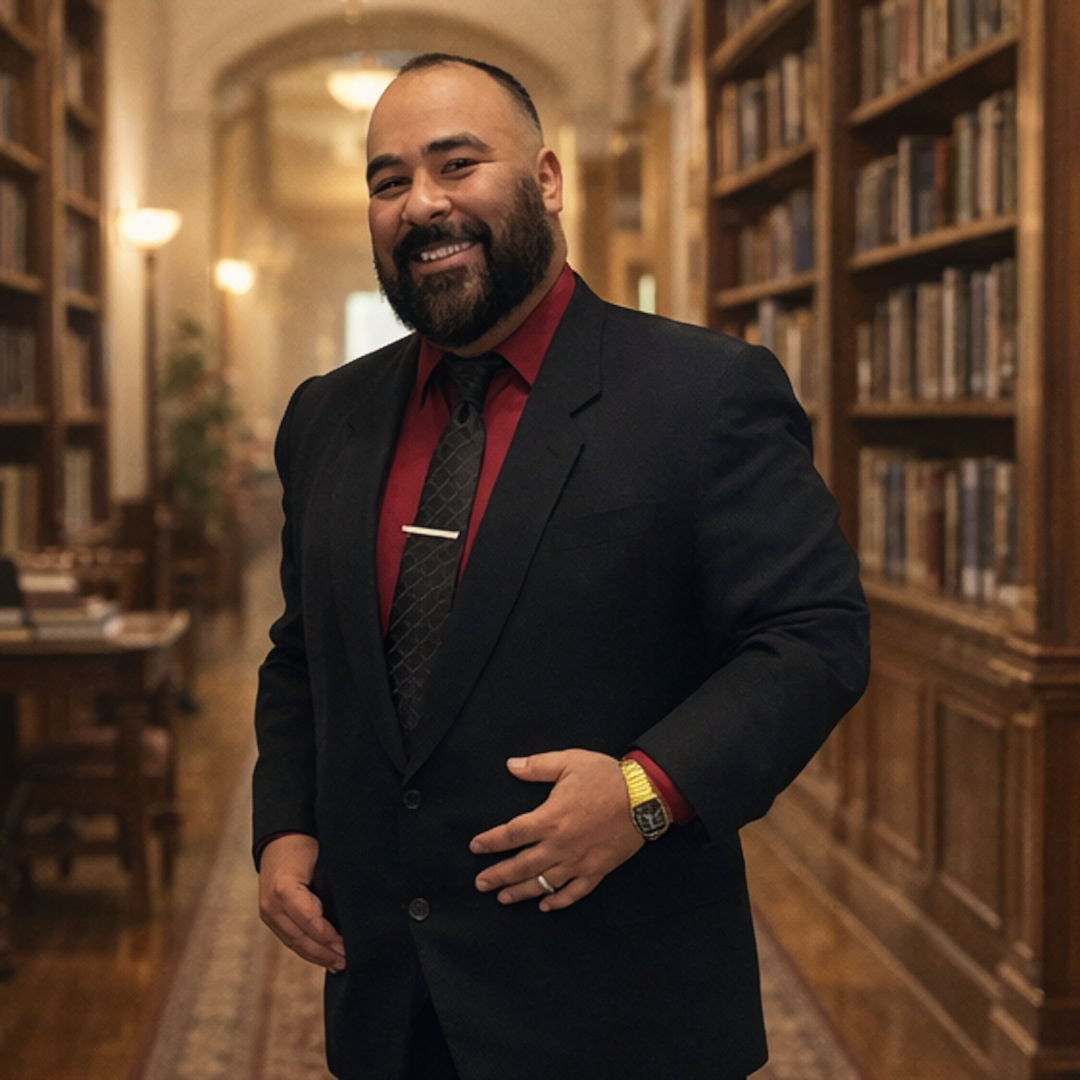
Joshua R. GutierrezFounder & Lead Engineer, Axion Deep Digital
SEO strategist and full-stack engineer who builds the audit tooling, then does the work. Technical SEO, Core Web Vitals, and content systems for SaaS and B2B.
View Joshua R. Gutierrez’s full profile & credentials →Ready to build a website that performs?
Let us audit your current site, identify the biggest opportunities, and build a plan to grow your traffic and leads.